


By
Kabiru Danladi Lawanti
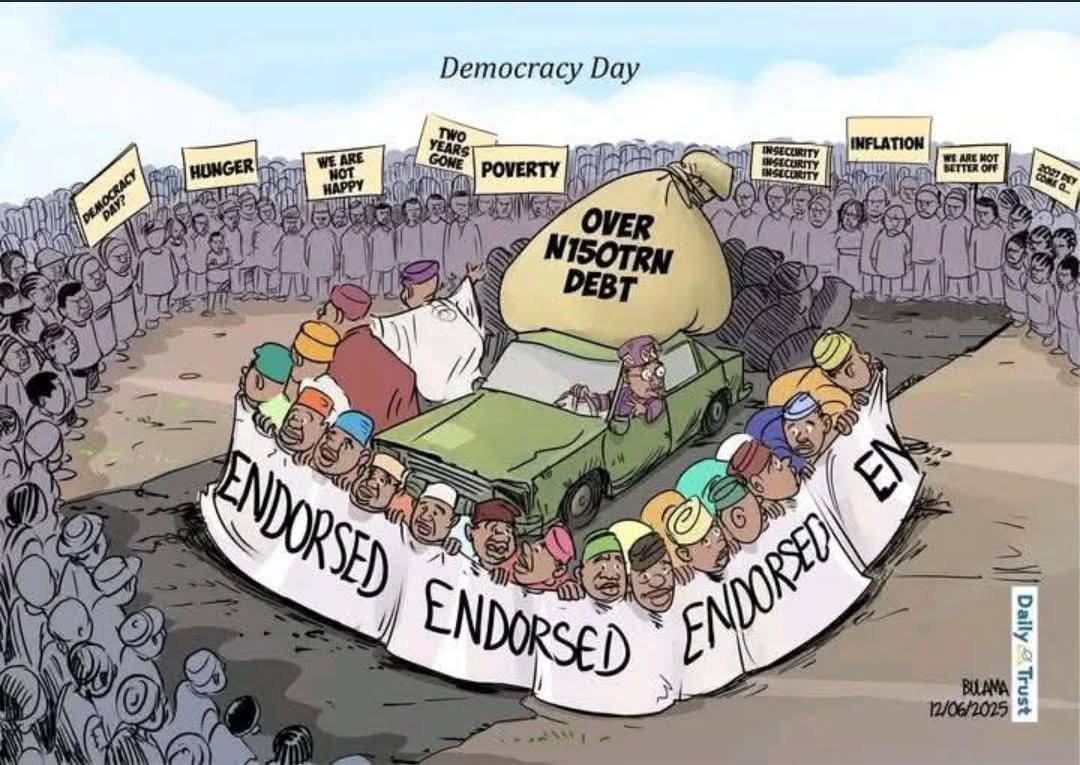
As someone who witnessed twenty-seven years of democratic governance in Nigeria – from the euphoria of the Fourth Republic’s birth in 1999, through the dashed hopes of the Obasanjo era, the Yar’Adua interlude, the Jonathan turbulence, the Buhari’s economic confusion, to the current Tinubu “subsidy is gone”, it is becoming increasingly difficult to make sense of the Nigerian democratic experience. For almost 3 decades now, the country has been governed by elected political leaders under what we proudly describe as democratic governance. Yet, for many Nigerians, the fundamental promise that accompanied the transition from military rule – the promise of good governance, accountability, prosperity, and improved welfare – has remained largely unfulfilled. The democratic illusion is no longer an abstract concept but a lived, visceral experience.
To be fair, Nigeria has recorded notable developments during this period. Telecommunications have expanded dramatically, major infrastructure projects have been undertaken, and democratic institutions have become more entrenched than they were during the years of military dictatorship. However, these achievements have not translated into a corresponding improvement in the everyday lives of the majority of citizens. Across the country, millions continue to grapple with multidimensional poverty, widespread insecurity, unemployment, deteriorating educational standards, inadequate healthcare services, poor transportation systems, and an ever-rising cost of living. For many ordinary Nigerians, life today is not significantly better than it was decades ago; in some respects, it has become even more precarious.
The disconnect between democratic promises and lived realities has created a deep sense of frustration. Democracy was expected to deliver more than periodic elections; it was expected to improve the welfare of citizens and provide responsive governance. Yet political actors have too often prioritized personal ambition, elite competition, and access to state resources over the collective interests of the people. The recurring spectacle of politicians switching parties without ideological conviction, the persistence of corruption scandals, and the failure to address basic social challenges have steadily eroded public confidence in the political class.
One is reminded of the popular saying often heard in Nigerian motor parks, “mai shayi joints” and market squares; “We voted for democracy, but we are still waiting for its dividends.” The “democratic dividends” slogan of the early 2000s has vanished into thin air. This sentiment captures the disappointment of ordinary Nigerians who believed that the end of military rule would usher in a new era of development and social justice. Instead, many have come to view democracy or democratic governance and elections as periodic exercises that change political officeholders without fundamentally altering the conditions of ordinary people’s life.
They voted or watched people who became state governors who could not account for the monthly federal allocations yet are returned re-elected through the machinery of patronage and other primordial sentiments. They also observed how the National Assembly, meant to be the bastion of representation, became a marketplace where legislative votes were traded for executive favour.
The tragedy is not just politicians have failed Nigerians; it is that their failures have weakened public faith in democratic governance itself. When citizens continue to endure poverty, insecurity, and exclusion despite nearly three decades of uninterrupted democracy, it becomes increasingly difficult to convince them that democracy is working in their interests. Democracy, after all, derives its legitimacy not only from elections but also from its ability to improve the lives of the people. Where that capacity is absent, democracy risks becoming an empty ritual rather than a meaningful system of governance.
Nigeria’s challenge today is not simply to preserve democracy, but to make it work for ordinary citizens. Until governance begins to translate into tangible improvements in people’s lives, the democratic promise will remain a mirage, and public disillusionment will continue to grow.
Photo credit: New Bulama’s Cartoons