


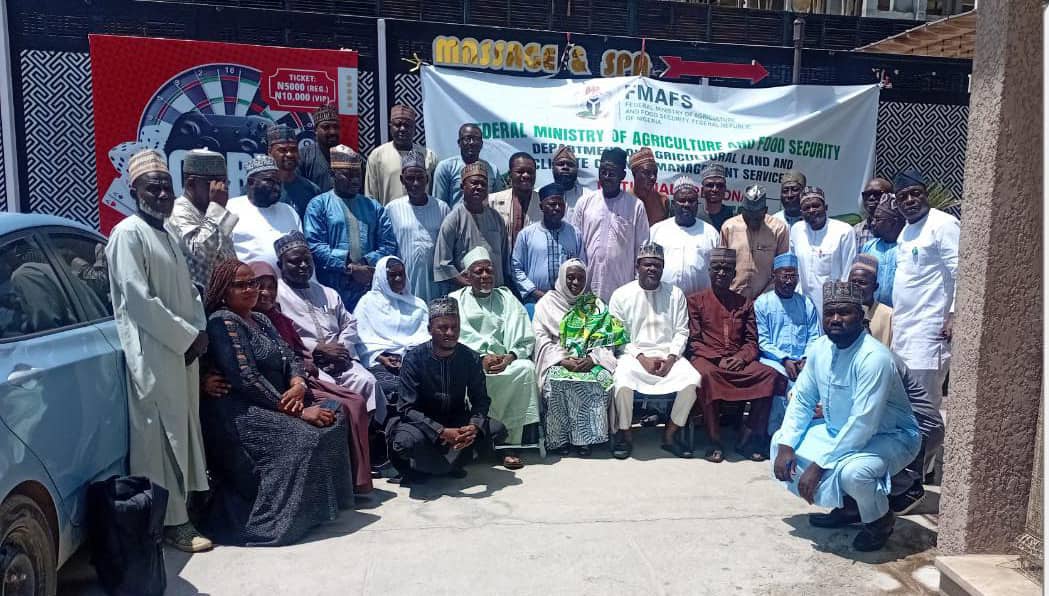
The Federal Ministry of Agriculture and Food Security has commenced a regional stakeholders’ consultation on the review and development of the Nigeria Agricultural Land and Soil Management Policy, NALSMP, 2027–2035.
The two-day North-West zonal workshop, which opened on Wednesday in Kano, is aimed at gathering inputs from key stakeholders toward developing a responsive and sustainable framework for managing Nigeria’s agricultural land and soil resources.
Read also: 17 BRIGADE NIGERIAN ARMY CONDUCTS TREE PLANTING EXERCISE IN KATSINA
The Director, Agricultural Land and Climate Change Management Services in the ministry, Olanipẹkun Oshadiya, said the policy review was crucial to the country’s quest for food security.
Oshadiya, who was represented by his Personal Assistant on Gender and Innovation, Wasiu Oyediran, said agricultural land and soil were the bedrock of Nigeria’s food system, and that their productivity and sustainability were critical to improving food production, livelihoods, environmental protection and national development.
He said the country’s agricultural resources were increasingly threatened by soil degradation, erosion, nutrient depletion, deforestation, climate change, population growth, urban expansion and competing land demands.
According to him, the consequences are already visible in declining soil fertility and productivity, increased vulnerability of farmers to climate-related shocks, loss of soil organic matter, erosion and desertification.
“If soil quality deteriorates, agriculture will inevitably suffer. A decline in agriculture means a lack of food for our citizens, insufficient raw materials for industries and a deficit in commodities for foreign exchange.
“We cannot afford to maintain the current situation and continue relying on food imports for a population of 230 million,” he said.
Oshadiya said the review was not merely about amending an existing document, but about creating an inclusive, science-driven and actionable policy framework capable of addressing present and future challenges.
He urged stakeholders to focus on sustainable soil management, climate-smart agriculture, land degradation and restoration, land governance, land-use planning, soil information systems, research and innovation, as well as financing and investment.
He said the revised policy should promote practices capable of restoring soil fertility, improving soil organic matter and enhancing the resilience of agricultural systems against droughts, floods, extreme temperatures and other climate-related challenges.
He also stressed the need for stronger coordination among the Federal, State and Local Governments, traditional institutions, communities, research institutions, development partners and the private sector.
According to him, reliable data on soil characteristics, land capability, degradation and suitability would be vital for evidence-based agricultural planning.
Oshadiya said the ministry, in collaboration with development partners, had made significant progress in the past two years, including the development of the Nigerian Soil Information System, NiSS.
Read also: DG LAND FORCES SIMULATION CENTRE NIGERIA DECORATES CAPT JU JIBRILLA TO THE RANK OF MAJOR
He said the system would provide soil data and digital advisories at the Local Government Area level, enabling farmers to access information on soil pH, organic matter and appropriate fertiliser recommendations.
He added that the ministry was also integrating the National Fertilizer and Soil Health Strategy, NFSHS, into the ECOWAS Regional Fertilizer Hub.
Other initiatives, he said, included a partnership with the Bill and Melinda Gates Foundation on the GP Soil Matters initiative and the provision of modern laboratory equipment across 12 states.
He said the ministry would also revitalise soil-testing laboratories in the 36 states and the Federal Capital Territory, and retrain Agricultural Development Programme, ADP, agents on soil health diagnostics.
Oshadiya said the ministry was committed to ensuring that the revised policy was farmer-centred, affordable, locally appropriate, gender-responsive and accessible to smallholder farmers, while supporting commercial agriculture.
He stressed the need for clear implementation frameworks, measurable targets, defined institutional responsibilities, funding mechanisms, monitoring and evaluation systems and accountability measures.
Also speaking, the Country Director, Soil Values Programme, Joshua Arogunyo, said the initiative was committed to working with relevant Nigerian institutions to ensure that soil management became an integral part of agricultural development and food security.
Similarly, the Director, Centre for Dryland Agriculture, CDA, Bayero University, Kano, Sanusi Mohammed Gaya, said the workshop was timely, particularly against the backdrop of climate change and increasing pressure on agricultural resources.
Gaya, who was represented by Mustafa Bello, said effective soil management was critical to sustainable agricultural development, and urged stakeholders to ensure that the outcomes of the workshop translated into practical interventions.
The Permanent Secretary, Kebbi State Ministry of Agriculture, Faruk Sarki, who spoke on behalf of the North-West states, commended the Federal Government for initiating the policy review.
He said agriculture remained critical to the economies of states in the region and stressed the need for policies that would strengthen agricultural resilience and sustainable land management.
The President, Soil Science Society of Nigeria, Jibrin Mohammed Jibrin, also stressed the importance of sound soil management to sustainable food production.
Read also: COAS CHAMPIONS ARCHERY, HARPS ON SPORTS AS STRATEGIC TOOL FOR NATIONAL COHESION AND SECURITY
The Lead Consultant for NALSMP, James Jayeoba, presented a paper titled, “Overview of the NALSMP Development Process, Objectives and Expected Outputs,” and led discussions on “Agro-Ecological, Land and Soil Zones: Priorities and Local Realities.”
Representatives of the ministries of agriculture from Kaduna, Kano, Katsina, Jigawa, Zamfara, Kebbi and Sokoto states, as well as farmers’ organisations, AFAN, Sasakawa Africa Association, small-scale farmers and other stakeholders, delivered goodwill messages.