


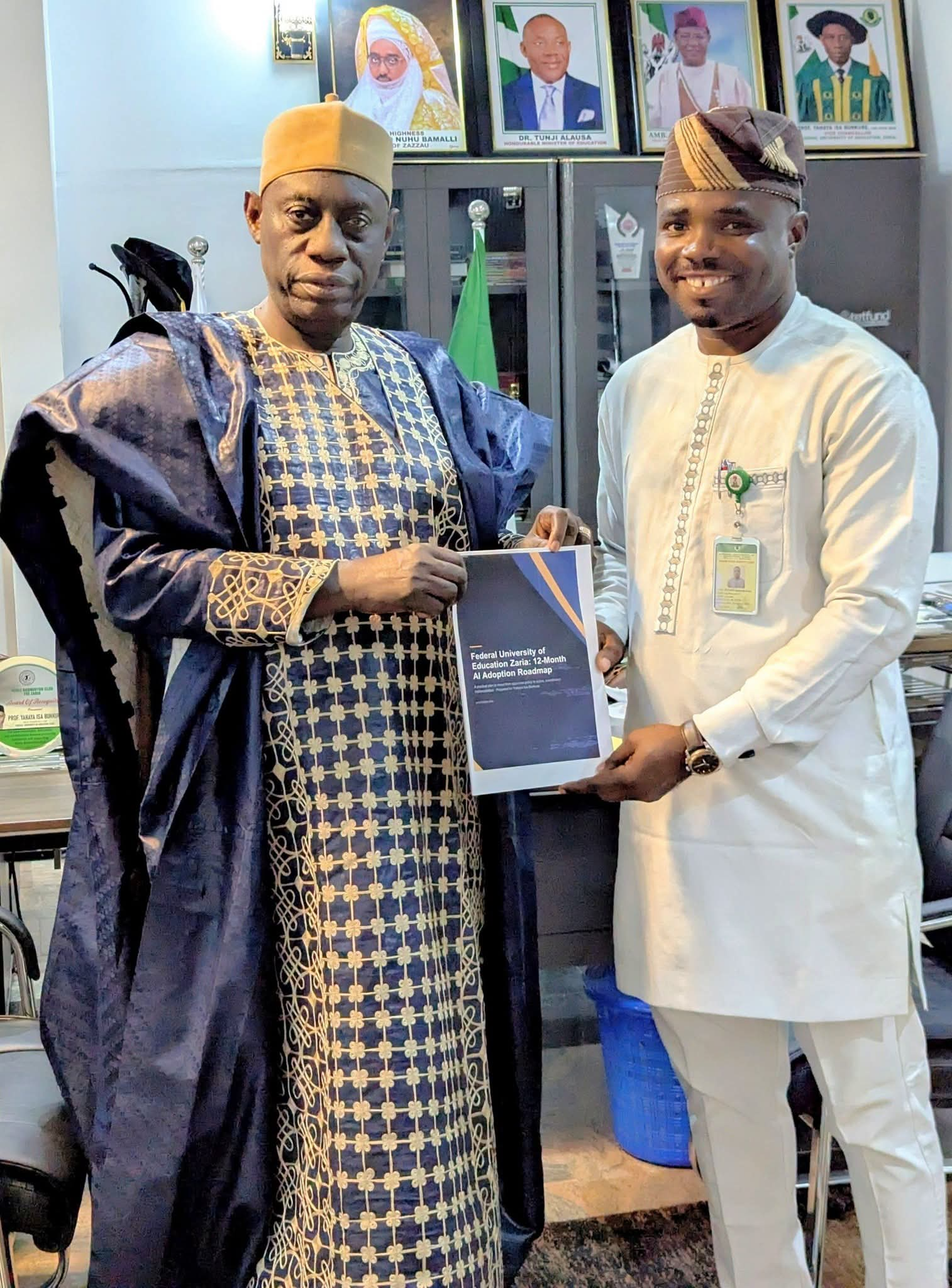
The Federal University of Education, Zaria, has taken deliberate moves to enhance the adoption and coordinated use of Artificial Intelligence (AI) across its academic and administrative activities as the Vice-Chancellor, Prof. Yahaya Isa Bunkure unveiled a 12-month roadmap for the implementation of the University’s AI policy.
This was contained in a statement signed by Sani Lawal Maqarphy, media aide to the VC made available to newsmen.
Read also: Zulum Orders Special Allowances for Teachers in Hard-to-Reach Communities
It said the roadmap, disclosed today, 29th October, 2026, at the Vice-Chancellor’s office, provides a structured approach to coordinating AI use, improving staff capacity, promoting academic integrity and extending AI literacy to undergraduate and postgraduate students.
It comes at a time when the use of AI tools among academic staff, professional staff and students is growing, but remains largely uncoordinated. The roadmap therefore seeks to bridge the gap between the University’s approved AI policy and its practical implementation.
Under the plan, the first three months will focus on activating the University’s centralised AI office or centre of excellence, assessing the use of AI tools across faculties and establishing a working group with representation from academic staff, professional staff and students.
The second phase, covering months four to six, will prioritise staff training and capacity development through structured AI literacy programmes. It will also involve the creation of a shared resource library and the identification of AI champions in faculties to support the adoption of the technology.
The third phase will focus on strengthening academic integrity through a review of existing assessment policies and the development of consistent institutional guidelines for AI-assisted academic work, while also laying guidance for academic staff on the use of AI and approaches to detection.
Read also: Education Must Align With 21st-Century Workplace Demands – Sanusi
During the final three months, the University intends to extend AI literacy initiatives to undergraduate and postgraduate students through structured induction and curriculum activities. A year-end review will assess progress and identify areas requiring further improvement.
The roadmap recognises financial constraints as a major challenge but proposes that the University make progress by coordinating the use of existing free and vendor-provided AI tools, rather than waiting for major new investments in infrastructure, as it sought
It places staff AI literacy and capability development among the immediate priorities, emphasising the need to equip personnel with the knowledge and confidence to apply AI effectively in their respective roles.
The plan also identifies the need for consistent guidance on AI use in assessed work to address differences in practice across faculties and promote a more uniform approach to academic integrity.
Other proposed measures include documenting AI adoption across the University, monitoring relevant external guidance on AI in education and building evidence to support future funding requests and evidence would include staff confidence levels, adoption rates and academic integrity incidents.
The roadmap identifies the activation of the AI office, an audit of current AI use, staff literacy programmes and the revision of assessment policies as high-priority actions, while the establishment of a cross-faculty working group and the development of evidence for future investment are also outlined as important steps.
Read also: Prof Aliyu Rafindadi Sanusi will serve for another two years as ABU Deputy Vice-Chancellor
Organised into phases for implementation, it gives a clear path and establishs a coordinated approach to AI adoption, strengthen the capacity of staff and students, and provide a framework for monitoring progress over the next 12 months.
The Vice-Chancellor was assisted while unveiling the document by the Director of Information and Communication Technology (ICT), Dr. Ayotunde Fadele Abala.