
The Chief of Accounts and Budget (CAB) Army Major General TT Siddick, has described training as the most valuable form of welfare that can be provided to military personnel, emphasizing its critical role in enhancing professionalism, discipline, and operational effectiveness.
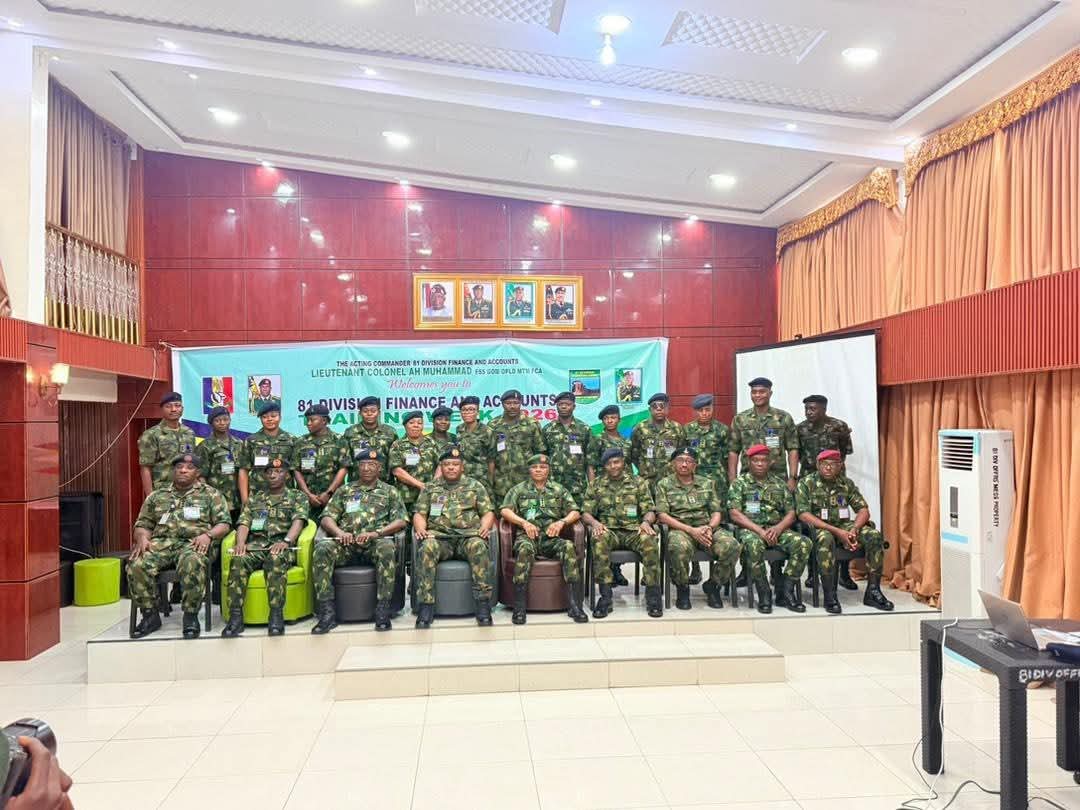
A statement signed by Lieutenant Colonel Musa Yahaya,acting Deputy director army public relations,81 division Nigerian army said Major General Siddick made this assertion on Wednesday, 17 June 2026, while declaring open the 81 Division Finance and Accounts Training Week 2026 at the 81 Division Officers’ Mess, Outer Marina, Lagos.
Represented by the Commander, Army Personnel Pay Office (APPO), Brigadier General IA Basharu, the CAB (A) noted that training remains one of the most effective tools employed by the Nigerian Army to build capacity, strengthen discipline, foster regimentation, and improve operational efficiency. He expressed satisfaction that the Nigerian Army Finance Corps (NAFC) continues to place a high premium on the professional development of its officers and soldiers to ensure efficient and effective financial service delivery.
He stated that since assuming office, he has consistently championed purposeful, result-oriented, and impact-driven training programmes. According to him, the focus should not merely be on conducting training activities but on ensuring that such programmes translate into improved competence, innovation, and measurable improvements in financial management across formations and units.
Maj Gen Siddick highlighted the Corps’ commitment to developing digital competencies, promoting the practical application of International Public Sector Accounting Standards (IPSAS), and strengthening financial accountability and other critical professional skills required to address contemporary challenges. He noted that these efforts are in line with his mission statement: “To Advance the Professionalism and Digital Technology Transformation of the NAFC for the Smart Delivery of Robust Financial Services Capable of Achieving the High Morale Needed by Nigerian Army Troops for Mission Success in Defending the Territorial Integrity of Nigeria within a Joint and Multi-Agency Environment.”
He described the theme of the training week, “Financial Records and Books of Accounts under IPSAS,” as both timely and relevant, noting that it aligns with the objectives of the 2026 Training Directives and reflects the Corps’ commitment to strengthening accountability, transparency, and professionalism in financial management.
He urged participants to continually update their knowledge and skills to keep pace with evolving accounting standards, technological advancements, and emerging financial management practices. He added that the carefully selected lecture topics and programme contents were designed to address contemporary professional challenges while supporting the attainment of the Corps’ strategic objectives.
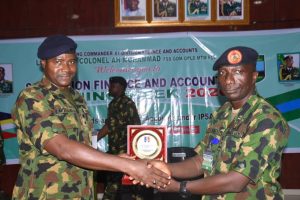
While commending the Commander and staff of 81 Division Finance and Accounts for organizing the capacity-building initiative, the CAB (A) encouraged participants to actively engage in lectures, discussions, and practical sessions. He urged them to ask insightful questions, contribute meaningfully to deliberations, and foster an atmosphere of learning, collaboration, and professional growth.
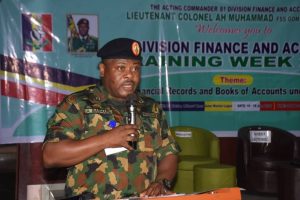
Earlier in his welcome address, the Commander, 81 Division Finance and Accounts, Lieutenant Colonel AH Muhammad, welcomed the Special Guest of Honour, the Chief Host, representatives of Corps Commanders, senior officers, officers, and participants to the training week. He described the programme as an important platform for enhancing professional knowledge, sharpening skills, and exploring innovative ideas that will improve service delivery while aligning participants with the CAB’s mission statement.
Lieutenant Colonel Muhammad observed that the rapid transformation in digital technology remains one of the major challenges confronting the profession, stressing the need for officers and soldiers of the Corps to continuously adapt in order to deliver more efficient services.
He further noted that the adoption of IPSAS as the global standard for public sector accounting, coupled with statutory compliance requirements in Nigeria, presents additional professional demands. He therefore emphasized the need for continuous training to enable personnel keep pace with evolving professional standards, ongoing digital transformation within the NAFC, and the Corps’ training directives.
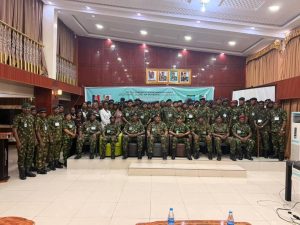
The 3 day training programme is expected to equip participants with the requisite knowledge and practical skills necessary to enhance financial accountability, improve record-keeping, and strengthen financial management practices across the Nigerian Army.