


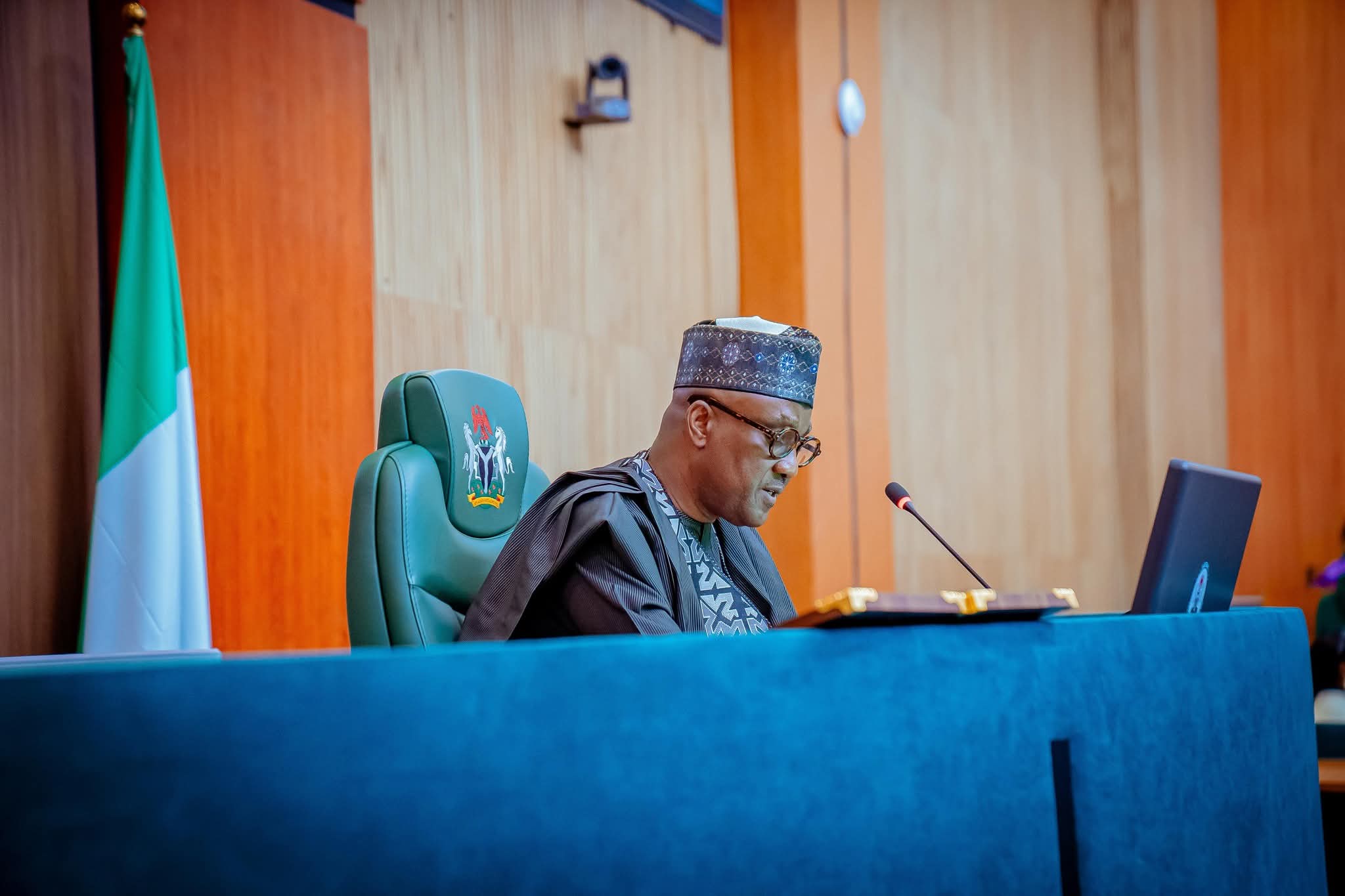
The historic push to decentralize policing in Nigeria has taken a major leap forward. Speaking at the National Security Roundtable during the NASS Open Week, the Speaker of the House of Representatives, Rt. Hon. Abbas Tajudeen, Ph.D., GCON, threw his weight behind President Bola Ahmed Tinubu’s executive bill to create state police.
However, the Speaker issued a vital warning: Nigeria must establish strict standards before building the actual physical structures.
Acknowledging that a nation of over 200 million people can no longer be effectively policed from a single capital, Speaker Abbas praised President Tinubu for having the courage to present a concrete constitutional amendment bill—a move many leaders only talked about for three decades.
Yet, to ensure this monumental shift does not descend into chaos, the Speaker outlined three non-negotiable operational pillars.
First, he insisted that a National Minimum Standards Act must be fully enacted before any state police force issues its first directive. Second, he cautioned against the shock of launching 36 state forces simultaneously, advocating instead for a gradual, state-by-state transition modeled after the successful decentralized systems in Germany and Canada
Finally, he stressed that financing mechanisms—whether through dedicated policing funds, shared services, or standard-tied federal support—must be settled upfront.
This ensures no state creates a force it cannot pay, preventing unpaid officers from becoming security threats to the very public they swore to protect.
A primary concern surrounding the state police debate is the fear that local forces could be weaponized by state governors or political godfathers. Speaker Abbas addressed these anxieties head-on, pointing to the robust constitutional safeguards built directly into the proposed executive bill.
Under the new framework, a state Commissioner of Police will be appointed based on the recommendation of the National Police Council, subject to confirmation by the State House of Assembly.
To protect these officers from arbitrary dismissal, a Commissioner can only be removed by a two-thirds majority of the State Assembly, and strictly for “good cause.”
Furthermore, if a state police force breaks down, abuses its power, or turns against citizens, the federal police can legally step in. This intervention is strictly bound by law: it must be done in writing, for a limited time, with 48 hours’ notice to the governor and National Assembly, and remains fully subject to judicial review.
“Local policing succeeds only where national standards, shared information, and firm accountability hold it together. Where those are missing, a police force can become a danger to the very people it was created to protect. Let us take what is strong in these models, and let us avoid what has failed in them.”Speaker Abbas Tajudeen said.
Beyond restructuring, the Speaker emphasized that funding alone is not a security strategy. He urged the legislature to prioritize modernizing the entire security architecture through law.
This includes building a shared, modern criminal and biometric database so suspects cannot escape detection by crossing state lines, establishing legal frameworks for inter-agency intelligence sharing, and utilizing rigorous legislative oversight to hold all security agencies accountable.
With key stakeholders, security experts, and policymakers in attendance—including Kaduna State Governor Senator Uba Sani and House Committee on Defence Chairman Hon. Babajimi Benson the roundtable underscored a unified legislative resolve: to deliver a localized, accountable, and modern policing system that Nigerians can finally trust.