
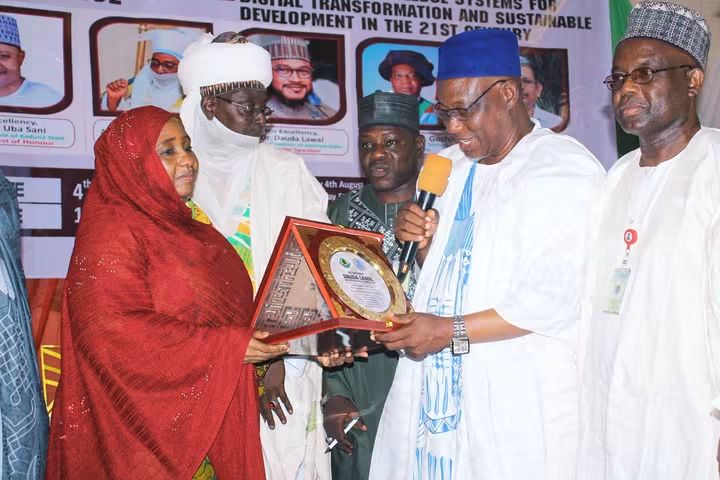
The Executive Governor of Zamfara State, His Excellency Dr. Dauda Lawal, has advocated a fundamental shift in Nigeria’s education system from certificate-based learning to capability-driven education to equip young people with entrepreneurial, innovative and digital skills for the future.
A statement signed by Sani Lawal Maqarphy media aide to the VC said Governor Lawal made the call in a keynote address delivered on his behalf by the Permanent Secretary, Zamfara State Ministry of Education, Science and Technology, Hajiya Maryam Yahaya Shantali, at the First International Hybrid Conference organised by the Faculty of Social Sciences Education, Federal University of Education, Zaria, from 4th to 6th August, 2026.
Speaking on the sub-theme, “From Certificates to Capability: Entrepreneurship Education, Innovation and Skills Development for Youth Employment in the Digital Age – The Zamfara Experience,” the Governor said Nigeria’s education system must move beyond the mere award of certificates to producing graduates equipped with practical skills, entrepreneurial competence and digital literacy.
He noted that the country’s education system had for decades focused on examinations and certification rather than the development of competencies required for productivity and self-reliance, stressing that entrepreneurship education should be integrated into teaching and learning as a practical approach to solving real-life problems.
Governor Lawal observed that digital transformation should serve as a catalyst for improving educational delivery and expanding opportunities for innovation, rather than replacing sound educational policies and effective teaching methods.
Highlighting reforms undertaken by the Zamfara State Government, he said the declaration of a State of Emergency on Education had accelerated investments in school infrastructure, teacher recruitment, technical and vocational education, digital literacy and improved governance across the education sector.
The Governor disclosed that the state had introduced eighteen technical and vocational subjects in secondary schools, recruited qualified teachers through a merit-based process and established the Zamfara Institute of Information Technology to prepare young people for emerging opportunities in the digital economy.
He also highlighted the government’s investments in school feeding, construction of new schools, teacher capacity development and strategic partnerships with technology organisations aimed at improving digital skills and enhancing youth employability.
Governor Lawal identified overdependence on certificates, curricula disconnected from labour market needs, poor perception of technical and vocational education and weak data-driven administration as major challenges confronting the nation’s education system.
According to him, addressing these challenges requires stronger collaboration among governments, educational institutions, industry and development partners to build an education system that promotes innovation, enterprise and sustainable development.
The Governor further called on universities and researchers to support educational reforms through evidence-based research, curriculum development, teacher education and the design of assessment systems that prioritise capability over memorisation.
He reaffirmed the commitment of the Zamfara State Government to building an education system that empowers learners with practical knowledge and skills capable of driving economic growth and national development.
The three-day international conference brought together scholars, researchers, policymakers and development partners from within and outside Nigeria to deliberate on strategies for reimagining knowledge systems for digital transformation and sustainable development in the 21st century.