


By Abdullahi Yusuf
A developed Sign Language Version of the Glossary of Legal Terminologies was on Thursday unveiled in Kano to enable sign language Interpreters to assist people with hearing impairment to communicate and fully participate in the administration of criminal justice in the state.
The Glossary is to be used by sign language interpreters to help people with hearing impairment to express themselves in cases involving them in the court of law.
The document which contains more than 200 signs was launched at a Training and Dissemination Workshop on the Developed Sign Language Versions of the Legal Terminologies for Sign Language Interpreters in Kano State.
The programme which was held at the Tahir Guest Palace Hotel,was organized by the State Ministry of Women Affairs, Children and People Living With Disabilities, and supported by the International Institute for Democracy and Electoral Assistance(IDEA).
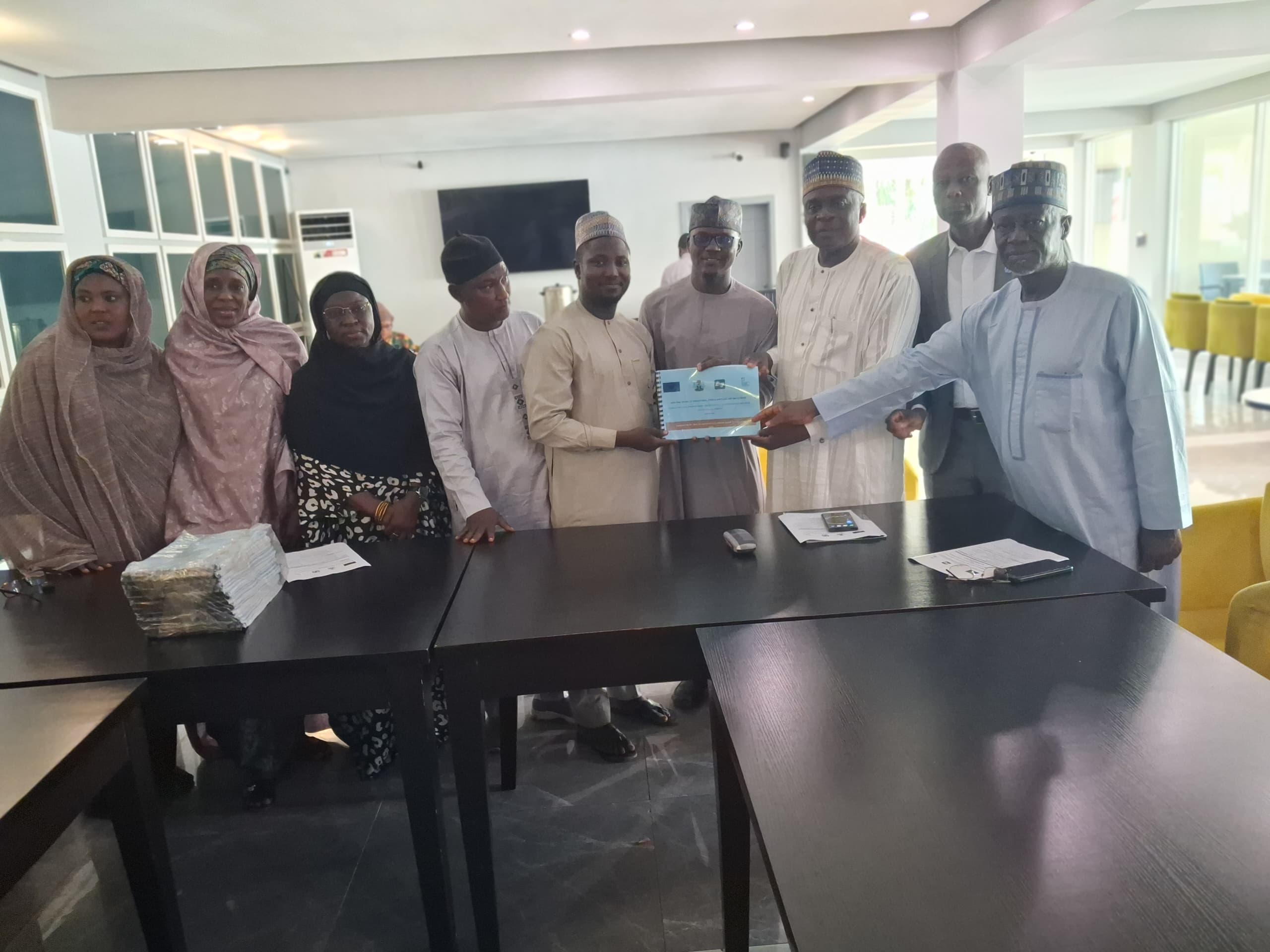
The State Commissioner for Women Affairs, Children and People Living With Disabilities, Hajiya Amina Abdullahi,represented by the ministry’s Deputy Director, People Living With Disabilities, Tahir Shehu, handed over the Glossary to the Chairman,Kano State Branch of Sign Language Interpreters Association of Nigeria(ASLIN),Malam Sagir.
The Commissioner expressed delight at the unveiling of the document and commended all the stakeholders involved in the actualisation of the Initiative.
Earlier, the Kano State Project Coordinator, Rule of Law and Anti Corruption(RoLAC), Malam Ibrahim Bello,described the Initiative as “a milestone in our efforts to support the State, especially the community of people with hard of hearing in our society,by carrying them along in the introduction of administration of criminal justice law of 2019 which is now the prevailing criminal justice law that is being implemented not only in Kano State, but across Nigeria.”
“This is a new law that was introduced in Nigeria in 2015 and was introduced or domesticated in Kano in 2019, and as a new law, it contains numerous legal terminologies that hitherto did not have a sign language version of these terminologies.
“So,RoLAC felt the need to carry along our brothers and sisters that are of hard of hearing, or deaf totally, so that they can be able to communicate and also participate fully within their framework of administration of criminal justice by understanding those new legal terminologies,” Bello said.
He disclosed that the 60-page Glossary of sign language version of legal terminologies was developed by Prof.Kyauta Ibrahim, and that it took several months to produce.
Giving an overview of the Glossary,Prof.Kyauta said the objective of producing the document was to teach sign language interpreters the sign language version of legal terminologies so as to help persons with hearing impairment communicate very well when they have a case in Court.
He said this assistance would go a long way in enabling the persons with hearing impairment to obtain justice in the court cases they are involved in.
He, therefore, urged the interpreters to use the Glossary judiciously so that they would be able to assist the hearing impaired persons in giving their own side of the story in the court of law.
Topics discussed during the one-day workshop included:”Legal Framework on Access to Justice for Persons with Disability with Focus on Deaf and Hard of Hearing Persons,” and “Understanding Disability in the Context of Deaf and Hard of Hearing Persons.”
Others were:”Who is a Sign Language Interpreter,” “Primary Duty of a Sign Language Interpreter,” and “Key and Qualities for Effective Sign Language Interpreting.”