
By Umar Dankano Yola.
The United Nations Children’s Fund, UNICEF has urged the twenty one local government chairmen to as a matter of utmost importance allocate budgetary provisions for water, and hygiene (WASH) activities in their respective councils in Adamawa state.
Officials of the UNICEF made the call after their inspection visits to Shelleng and Ganye local government areas on the implementation of the Accelerating Access to Water and Sanitation for All (ASWA III) and Water, sanitation, health and nutrition in the duo local councils in the state.
They also stressed the importance of escalating more local government areas to become Open Defecation Free, ODF with community ownership, behavioural change and climate-resilient infrastructure emerging as key pillars of the intervention.
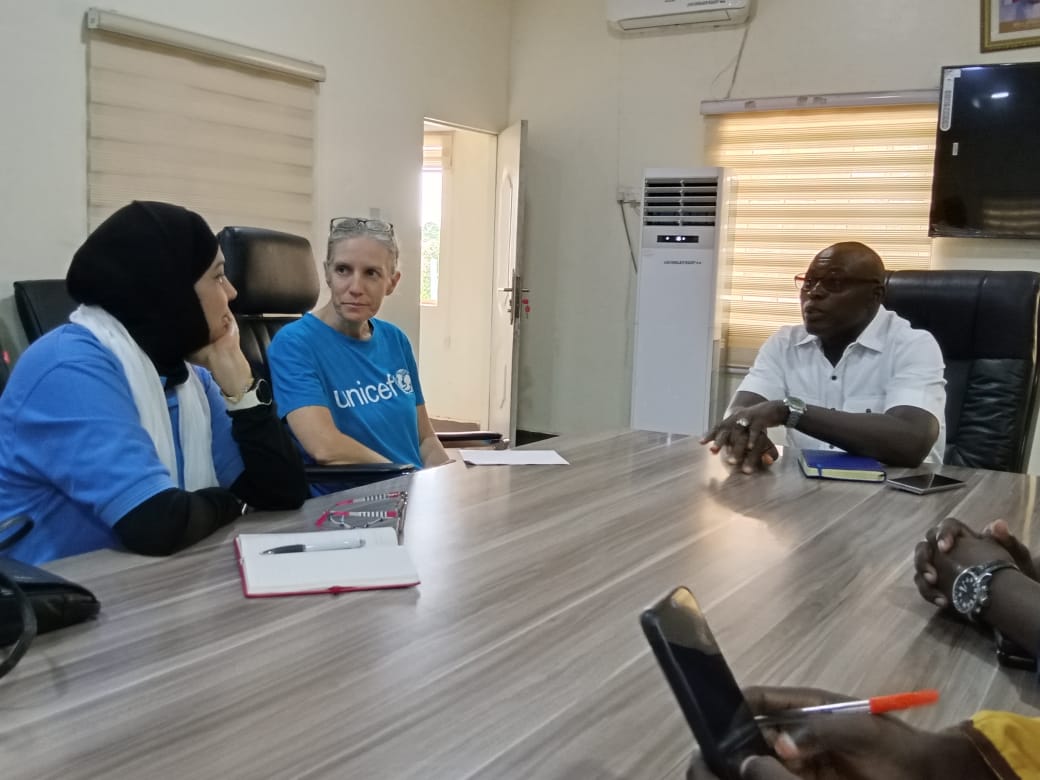
In her submission at an accessement briefing of the inspection tour with the Adamawa state government officials in Yola on Wednesday, Chief of Water, Sanitation and Hygiene(WASH) Nigeria, Emily Rand expressed satisfaction with the success recorded in most the comm unities visited.
Rand said the ODF activity had recorded remarkable feat noting that some have reached high level of progress while others are at considerable stage and are still on the move to attaining ODF status in the two pilot councils.
Rand attested that the programme has inculcated behavioural change among the households in which they wash their hands with soap after answering calls of nature and construction as well as use of their rest rooms (toilets).
She explained that the beauty of the program can never be over emphasized especially the promotion of hygiene practices by the residents.
According to her part of the interventions by the UNICEF through funding support from the Republic of Netherlands include ;16 water facilities in various health facilities, schools while six additional facilities were ongoing in primary healthcare centres adding that 15 more boreholes were expected to be provided under the programme.
While applauding the RUWASSA and other communities for the zeal shown on mobilization and ownership,Rand observed that leadership by men and women in the communities visited is encouraging with the formation of WASH local committees.
“What was exciting was the community engagement and the WASH committees being strong and vocal,” she said,
Speaking on the development, Chief of Unicef Bauchi field office, Dr.Nuzhat Rafique said that the WASH committees were meant for awareness campaign and facilitations in various communities.
Dr.Rafique advanced that the program has demonstrated high sense of responsibility and collectivity based on the fact that the local even build their own toilets with their own resources.
She commended the efforts of the state government in ensuring prompt payment of counterpart funding in all intervention s in the state.
Earlier speaking on behalf of the Adamawa state government, General Manager of RUWASSA, Mr.Esly Emmanuel expressed gratitude to the development partners especially the UNICEF for the various interventions in the area of health, water and hygiene.
Emmanuel, explained that the ODF process was deliberately designed without direct subsidies for household toilet construction. Instead, communities were taken through a process of awareness creation and facilitated to understand the health implications of open defecation.
Emmanuel confirmed that the rural residents provide their choices of toilet designs based on the capacity and circumstances in the areas adding that children and young people were also being incorporated into Community-Led Total Sanitation activities so that improved hygiene behaviour could become part of their upbringing
Our correspondent reports that the intervention is being implemented under the Accelerating Access to Water and Sanitation for All (ASWA III) programme, funded by the Netherlands Government and implemented by UNICEF in partnership with the Adamawa State Government.